The field problem
Before the trench closes, keep a record of what you found.
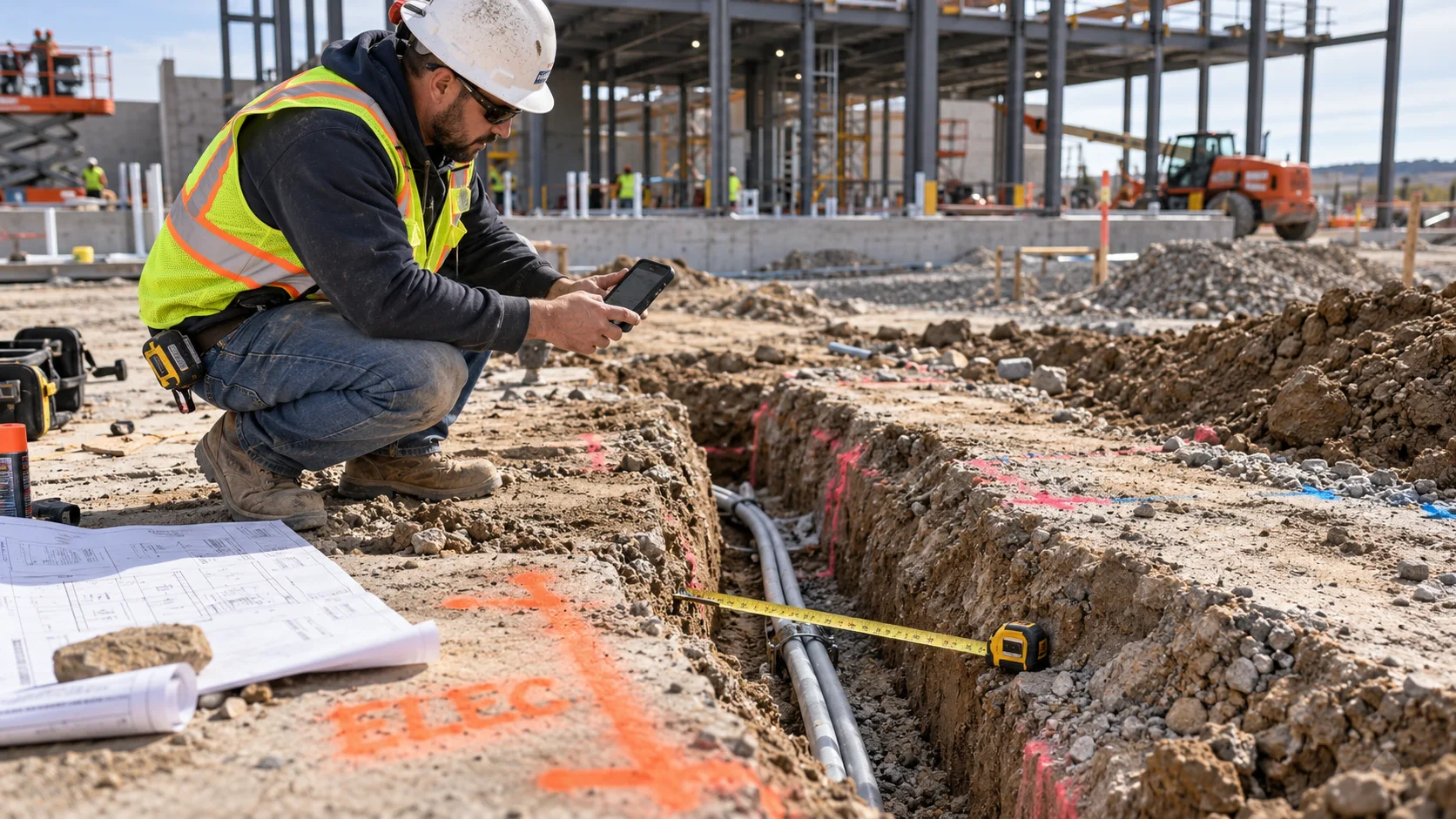
An open excavation gives your crew a view that the next person may never have. The route, the connection, and the difference from the drawing are visible now. After backfill, that context is much harder to reconstruct.
A photo on someone’s phone can capture the moment without explaining where it belongs. A note in a job folder can describe a finding without giving the client a practical way to retrieve it later.
What it means for the work
The project moves on. The unanswered questions stay.
A returning crew may know that a utility was exposed, but not which photo shows the relevant connection or what the field note meant. The client may receive closeout files without a clear link to the infrastructure those files describe.
When findings stay scattered across phones, messages, and project folders, later work can begin by reconstructing the same discovery. The record needs to survive both the backfill and the handoff.
A better starting point
Leave a record someone can use after your crew leaves.
Preserve what was actually observed, connect it to the documented asset or route, and explain what remains uncertain. The client and a returning crew should have a starting point that makes sense without the original observer standing beside them.
The handoff is not just a collection of files. It is the context behind the field finding.
How Valve Finder helps
Connect the field finding to the infrastructure it describes.
Valve Finder brings mapped assets, documented utility connections, photos, notes, and supporting records together. It gives field findings a place to live beyond an individual worker’s device or a single project conversation.
Capture the exposure
Document assets and utility routes while they are visible. Attach photos and notes that explain the observed conditions and the relationship between infrastructure elements.
Preserve the project context
Keep supporting documents with the relevant asset. Record differences from existing information and explain the limits of what your crew was able to observe.
Support a usable client handoff
Use connected asset records to share and review field findings with clients. The documented map and field-retrieval tools give later work a way back to the record.
A practical workflow
Make documentation part of the work before backfill.
This example describes a practical capture-and-handoff workflow. It is not a claim about a completed customer project or a substitute for project documentation requirements.
Identify what is exposed
Create or update the relevant mapped asset and documented connection. Distinguish what your crew observed from information carried forward from a plan or another source.
Capture photos with context
Photograph the exposure and its surroundings. Add notes describing the finding, the connection, and any discrepancy that a later worker or client should understand.
Review before conditions disappear
Check that the photos and notes are attached to the right record. State what was not exposed or verified instead of implying that the record describes everything underground.
Carry the record into the handoff
Review the connected findings with the client and preserve them for later work. A returning authorized worker can retrieve the record and compare it with current field conditions.
Valve Finder documents and visualizes recorded infrastructure information. It does not replace 811 utility locating, subsurface utility engineering, surveying, engineering services, or required excavation procedures.
Keep learning
Turn field findings into a lasting handoff.
Read about the gap between documenting a project and leaving information that operations can actually use.
Browse the Knowledge CenterWhy Every Locate Should Leave a Better Record
Connect an individual field discovery to a record the next person can retrieve.
Read articleFrom Construction Documentation to Operational Knowledge
Understand what makes a construction handoff useful after project closeout.
Read articleWhy As-Builts Aren’t Always Field Truth
Keep observed conditions distinct from what an earlier drawing describes.
Read articleYour next step
What would your client inherit if this trench closed today?
Explore Valve Finder’s documentation and field-retrieval approach. If you want to examine where findings get lost across your current project handoffs, start with the Infrastructure Asset Continuity Assessment.
Discuss your field-documentation workflow